
Most of the households I work with have built strong retirement savings, usually at least $750,000 to $1,000,000, yet they still feel nervous when it comes to planning for health care costs. Here’s some retirement healthcare good news: If you have a health savings account (HSA), you aren’t just holding a rainy day savings account for prescriptions. You have one of the most tax-beneficial financial instruments in your entire portfolio.
In this article, we’ll discuss how retirees should be using an HSA to maximize their resources in a tax-efficient way and how to synchronize a health savings account (HSA) with your overall financial plan.
Key Takeaways
- The Triple Threat Advantage: Unlike your IRA or 401(k), your HSA offers a triple tax benefit: tax-deductible contributions, tax-deferred growth, and tax-free withdrawals for healthcare.
- HSA to IRA Strategy: Once you turn 65, your HSA acts like a Traditional IRA for non-medical expenses (no 20% penalty), while remaining tax-free for medical costs like Medicare premiums.
- A Safety Net for Long-Term Care: You can strategically invest your HSA today to self-fund future home health care or pay for long-term care insurance premiums tax-free.
Why HSAs Matter Even in Retirement
In retirement, healthcare is one of the largest costs you’ll face outside of income taxes. Recent Fidelity estimates suggest a healthy 65-year-old couple may need approximately $345,000 to cover medical expenses for the rest of their life. The health savings account (HSA) is one of the only financial instruments designed to meet those health care costs head-on without letting income taxes get in the way.
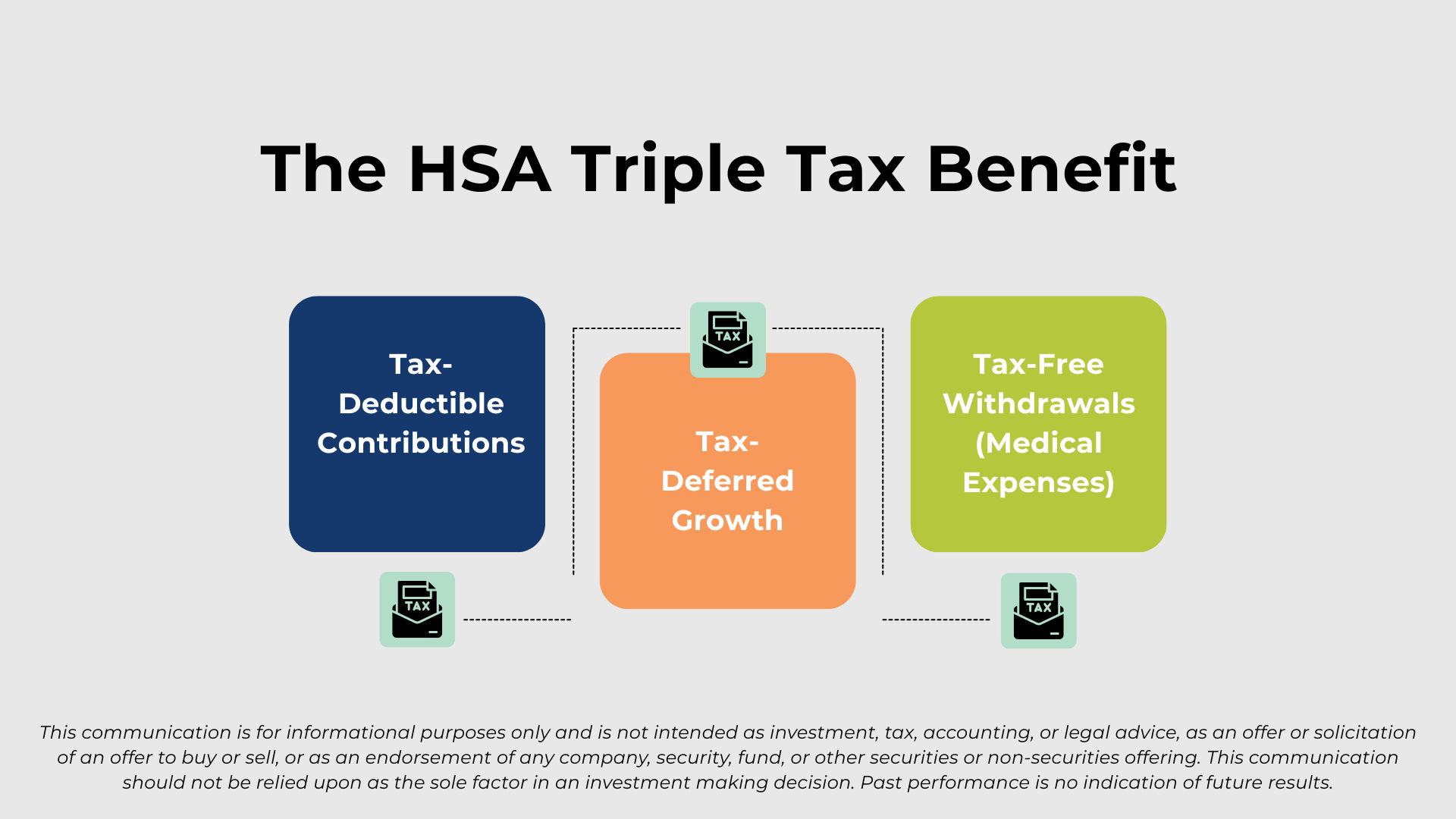
Most people use their health savings account like a bank account to pay for doctor’s visits or prescriptions. However, you might be surprised to learn that your HSA could be treated like a specialized retirement account. Your HSA can offer a “triple tax advantage” that even your 401(k) or IRA can’t match:
- HSA contributions are tax-deductible regardless of how much money you make.
- The money in your savings account can be invested, and its growth is tax-deferred just like your retirement accounts.
- Lastly, your withdrawals for qualified medical expenses are tax-free.
6 Ideas Retirees Should Consider with Their HSA
As you move from saving for retirement to living in retirement, your health savings account can start playing a much bigger role in your overall strategy. Instead of thinking of your HSA as a simple medical spending account, it can become a flexible tool for managing taxes, covering healthcare costs, and protecting your long-term financial stability.
Here are six practical ways retirees can use their HSA more strategically as part of their retirement plan:
- Take Full Advantage of the Triple Tax Benefit
- Use Your HSA to Cover Healthcare Costs in Retirement
- Invest Your HSA for Long-Term Growth Instead of Spending It Early
- Use HSAs Strategically For Non-Medical Expenses After Age 65
- Coordinate Your HSA With Your Withdrawal Tax Strategy
- Plan for Long-Term Care Costs
1. Take Full Advantage of the Triple Tax Benefit
Traditional retirement accounts offer a tax deduction for contributions, but you eventually pay taxes on your withdrawals. Roth IRAs do the opposite; they provide tax free income later in life, but you don’t receive an upfront deduction.The health savings account (HSA) offers the best of both worlds: an upfront tax deduction, tax deductible investment growth, and tax-free withdrawals when used for medical expenses.
These tax benefits aren’t restricted by how much money you make. Unlike a Roth IRA or a deductible Traditional IRA, which have strict income “phase-outs,” you can always contribute to and deduct your HSA as long as you have a high deductible health plan and are not yet on Medicare.
For my fellow Ohioans, there’s an extra bit of harmony in your retirement tax planning. While some states (like California or New Jersey) actually tax your HSA contributions at the state level, Ohio fully recognizes the federal tax advantages of HSAs. This means your contributions also help lower your Ohio state income tax.
Example: Consider a couple in Dayton, OH who decides to retire early at age 62 with $200,000 of annual retirement income. They haven’t enrolled in Medicare yet because they’re under 65 and are enrolled in a high deductible health plan. Because they aren’t working, they no longer have “earned income.” This means they can’t contribute to a Traditional IRA to receive a tax deduction.
Here’s the good news: Even without a paycheck, they can move money from their bank savings account into their HSA. Because HSA contributions don’t require earned income, they qualify for a tax deduction to lower their taxable income. And if they invest their contributions, the money can grow tax-deferred.
Alternatively, let’s say they retired at 58 and needed to pay for a surgery. Taking investment gains out of their Roth IRA might have triggered taxes or penalties because they aren’t 59.5 yet. But with their HSA, they can withdraw money tax free at any age to cover qualified medical expenses.
2. Use Your HSA to Cover Healthcare Costs in Retirement
Once you retire, you can use your health savings account for more than just prescriptions and doctor visits. Retirees over 65 can use their HSA funds to pay for Medicare premiums, including Part B, Part C (Medicare Advantage), and Part D prescription drug coverage.
By using your health savings account (HSA) for medical expenses, you allow your Social Security income to be used for regular living expenses, keeping the rhythm of your retirement spending exactly where you want it.
Example: A retired couple in Southern Ohio are both age 67. They each pay approximately $202.90/mo for Medicare Part B and another $34.50/mo for a Part D prescription plan.
They pay these premiums from their Social Security check for simplicity, but at the end of the year, they “reimburse” themselves $5,697.60 tax free from their HSA (the total annual cost for both).
3. Invest Your HSA for Long-Term Growth Instead of Spending It Early
Many people keep their HSA balance sitting in cash and spend it frequently for minor co-pays. However, if you have the income to pay your medical bills out of pocket, you could consider letting your health savings account (HSA) grow by investing it in a diversified portfolio.
Think of your HSA as a long-term investment vehicle for future medical expenses instead of a bank account. This shift lets compound interest do the heavy lifting of saving for medical expenses later in retirement.
You could even pay your medical expenses out of pocket now and save the receipts to reimburse yourself from your HSA in a few years. This keeps your account growing tax free in the meantime.
Example: A 55-year-old couple in Dayton, OH maxes out their HSA contributions every year, including the $1,000 “catch-up” contribution allowed for those over 55.
Over the next 10 years, they incur $20,000 in qualified medical expenses that include a knee surgery, physical therapy, and various prescriptions. Instead of using their HSA, they pay for these bills using their checking account and scan their receipts into a digital folder.
Because they paid their bills out of pocket, the $20,000 that would have been spent stayed invested in their HSA and grew at an average of 7% annually. After 10 years, that amount is now worth approximately $39,343.
At age 65, they decide to take a dream trip to Europe. They withdraw the original $20,000 from their HSA as a reimbursement for those old medical receipts. This distribution is tax-free, and they still have nearly $20,000 of invested money left in their account to cover future medical expenses.
4. Use HSAs Strategically For Non-Medical Expenses After Age 65
At age 65, the rules change with HSAs. While you should still prioritize using your health savings account for eligible medical expenses to keep your withdrawals tax free, you can withdraw money for non-medical reasons. Once you turn 65, you will pay ordinary income tax for non-eligible withdrawals (just like with your traditional retirement accounts), but the 20% penalty disappears. It effectively becomes a backup retirement account.
Example: Imagine a retiree in Dayton, OH age 67, who is taking a 5.3% annual distribution from their Traditional IRA to cover their lifestyle. Suddenly, they need an extra $15,000 to handle an urgent house repair. Taking that extra money from their IRA would push their withdrawal rate too high, potentially harming the sustainability of their investments.
Instead of putting more strain on their IRA, they choose to withdraw the $15,000 from their HSA. Since they are over 65, they will simply pay ordinary income tax on the distribution.
5. Coordinate Your HSA With Your Withdrawal Tax Strategy
Planning your retirement income is kind of like arranging a piece of music, where every account (instrument) needs to play its part at the right time. Similarly, your 401(k), IRA, Roth IRA, and HSA have the potential to work together at the right times to improve your retirement tax picture.
As you build your retirement withdrawal strategy, you could use your tax free HSA dollars for medical expenses instead of your IRA. This way, you’ll satisfy your spending needs without increasing your Adjusted Gross Income (AGI).
Blending your retirement income from multiple sources could create long-term tax savings. It could also prevent your Social Security benefits from being taxed at a higher rate or keep you from paying more than you need to for Medicare.
Example: Consider a married couple in Dayton with a retirement goal of $100,000 in annual spending. They have a mix of Social Security, a Traditional IRA, and an HSA.
They receive $40,000 from Social Security and take $60,000 from their Traditional IRA. The $60,000 withdrawal is fully taxable as ordinary income and is added to their AGI. If part of their overall spending needs is to cover a $10,000 medical bill, taking that money from the IRA might push their total taxable income into a higher bracket.
Alternatively, they could take the same $40,000 from Social Security and only $50,000 from their IRA. To cover the remaining $10,000 for that medical bill, they could use their HSA.
Because the $10,000 from the HSA is tax free, their reported taxable income for the year stays lower.
6. Plan for Long-Term Care Costs
Long-term care is a big worry for many of my clients. The good news is that you can use your HSA to pay for qualified medical expenses related to long-term care services, such as home health care, assisted living medical services, and skilled nursing.
Also, you can use it to pay for a portion of your long-term care insurance premiums. The IRS limits how much you can withdraw tax free for these premiums based on your age at the end of the year. According to IRS Revenue Procedure 2025-32, the 2026 limits are:
- Ages 61 to 70: Up to $4,960 per person.
- Over age 70: Up to $6,200 per person.
Example: Bob and Sue are both 55. They decide to max out their HSA contributions each year and invest their funds rather than spending them on current co-pays.
They contribute the 2026 family limit of $9,750 (which includes $1,000 in catch-up contributions) for the next 10 years until they enroll in Medicare at 65. If their account earns a 7% annual return, they could enter retirement with roughly $144,000 in their HSA.
They stop contributing at 65 but leave the money invested. By age 85 that balance could have grown to over $550,000, assuming continued 7% growth and no major withdrawals.
If Bob or Sue eventually needs home health care (averaging about $6,160 per month nationally in 2026), they can pay for those services directly from the HSA. Because they are using tax free dollars, they don’t have to sell stocks from their IRA and trigger large income taxes to pay for their care. They have essentially created their own private long-term care insurance policy using the power of the HSA triple tax advantage.
Common HSA Mistakes to Avoid
Even though HSAs offer powerful tax advantages, they can easily be underutilized if they’re not used strategically. Many retirees treat their HSA like a simple checking account for medical bills, which can cause them to miss out on the long-term tax and investment benefits the account provides.
Here are a few common HSA mistakes retirees should try to avoid:
- Spending too early
- Keeping your HSA in cash
- Forgetting documentation
- The age 65 and medicare enrollment contribution error
Spending Too Early
Probably the most common mistake would be using your HSA funds to cover minor co-pays when you could afford to pay cash and let your invested savings account grow. Regularly spending from your HSA means you are giving up the tax free investment gains and compounding. If your goal is to synchronize your assets for long-term retirement performance, treating your HSA as an investment rather than a spending account is important.
Keeping Your HSA in Cash
If you keep your HSA entirely in cash and don’t explore investing, you’ll miss out on years of market growth. While having some liquidity is wise so you don’t have to sell investments when the market is down, it’s smart for retirees to keep at least 1–2 years of medical expenses in cash and invest the rest for long-term tax savings.
Forgetting Documentation
If you reimburse yourself from your HSA for out-of-pocket medical expenses, you need to keep meticulous receipts. You can pay for a surgery today and reimburse yourself ten years from now, but only if you have the receipt to back it up. Each year, you report your HSA activity on IRS Form 8889. If you were ever audited, you’d need to show proof that your withdrawals were for qualified medical expenses.
The Age 65 & Medicare Enrollment Contribution Error
Once you enroll in any part of Medicare (Part A or B), you’re no longer eligible to put new money into an HSA. According to IRS Publication 969, contributions made while you are on Medicare are considered “excess contributions” and are subject to a 6% excise tax for every year they remain in the account. Also, ineligible contributions are not tax-deductible and must be reported as taxable income. To stay “Stage Ready” for retirement, consider halting your contributions a few months before you apply for Medicare.
How Much Should Retirees Keep in an HSA?
Ultimately, how much you keep in your health savings account depends on the role you want it to play in retirement.
For Total Healthcare Coverage
If your goal is for your HSA to cover the majority of your retirement health care costs, you might want to save between $200,000 and $300,000. This creates a dedicated financial instrument that can pay for everything from Medicare premiums to dental work without touching your other assets.
For Self-Funding Long-Term Care
If you plan to self-fund your care rather than buying a traditional LTC insurance policy, you might consider building an even higher HSA balance of $350,000 or more, given that nursing home costs can easily exceed $115,000 per year.
For a Medical Emergency Fund
If you want to use your HSA like an emergency fund, you might aim for a balance that covers at least a few years worth of estimated out-of-pocket maximums. For 2026, the IRS has set the high deductible health plan out-of-pocket maximums at:
- Self-only coverage: $8,500
- Family coverage: $17,000
Final Thoughts
Your health savings account is probably the most underrated instrument in your retirement plan. It has the potential to be a resource to cover all of your medical expenses with zero tax friction. If you shift from using your HSA as a spending account to a long-term investment vehicle, you can create a powerful, tax-efficient safety net.
Want an Expert to Help You Make the Most of Your Retirement? Contact Stage Ready Financial Planning Today for a No-Hassle, One-on-One Consultation
Stage Ready Financial Planning doesn’t just “crunch numbers.” My goal is to help bring order to the noise of retirement complexity. Whether it’s synchronizing your health savings account (HSA) with your overall taxable planning strategy or determining the right rhythm for your investment withdrawals, I’ll help you synchronize your retirement plan with your goals.
As a CFP® professional and fee-only financial advisor in Southwest Ohio, I work to bring the discipline of the conductor to the complexity of your portfolio, handling the math so you can enjoy the music.
Ready to see if your retirement plan is “Stage Ready”?
Schedule your intro call today!
Frequently Asked Questions (FAQs)
What happens to an HSA when you retire?
Unlike your flexible spending account (FSA), your health savings account is always portable. You don’t have to use it or lose it each year. Whatever you accumulate stays with you whether you leave your job or retire. You can roll your balance into a new HSA or keep it with your former employer’s plan.
Should retirees spend their HSA first or let it grow?
If you want to maximize your tax savings and you have other cash available, consider letting it grow. The longer you keep your HSA invested in a diversified portfolio, the more you can accumulate through compounded growth.
Are HSA withdrawals taxable in retirement?
For qualified medical expenses, withdrawals are always tax free. However, if you use your HSA for non-medical reasons under age 65, you’ll pay income taxes plus a 20% penalty. Once you turn 65, that 20% penalty disappears, but you will still pay ordinary income tax on non-medical withdrawals, similar to how your Traditional IRA works.
Is it better to keep an HSA in cash or invest it?
Better or worse depends on what you need to use your HSA money for. That said, investing funds that aren’t needed for immediate bills allows you to fully harness the “triple tax advantage”: an up-front tax deduction, tax-deferred growth, and tax free withdrawals for healthcare.
Can you keep contributing to an HSA after enrolling in Medicare?
No. Enrolling in any part of Medicare (Part A or B) makes you ineligible to make new HSA contributions. Be careful: if you apply for Social Security after age 65, your Medicare Part A coverage is often backdated by a few months. If you don’t stop your contributions in time, those backdated months could result in excess contributions that trigger income taxes and penalties.
About the Author

Joseph A. Eck, CFP®, is the owner and lead financial advisor at Stage Ready Financial Planning. He specializes in helping retirees and retirement savers over 50 navigate the complexity of retirement, focusing on tax efficiency and healthcare planning like optimizing your health savings account (HSA). With a teacher’s heart, Joseph helps Dayton-area families orchestrate a financial plan that allows them to live their ideal lifestyle without the fear of running out of money.
Article References
- Fidelity Investments. “Fidelity Investments® Releases 2025 Retiree Health Care Cost Estimate.” Accessed February 16, 2026. https://newsroom.fidelity.com/pressreleases/fidelity-investments–releases-2025-retiree-health-care-cost-estimate–a-timely-reminder-for-all-gen/s/3c62e988-12e2-4dc8-afb4-f44b06c6d52e
- LTC News. “IRS Boosts 2026 LTC Insurance Tax Deductions.” Accessed February 16, 2026. https://www.ltcnews.com/articles/irs-boosts-ltc-insurance-tax-deductions-business-hsa-benefits-ways-to-save
- IRS. “Revenue Procedure 2025-32.” Accessed February 16, 2026. https://www.irs.gov/pub/irs-drop/rp-25-32.pdf
- T. Rowe Price. “Tax-Efficient Retirement Income.” Accessed January 26, 2026. https://www.troweprice.com/content/dam/iinvestor/planning-and-research/t-rowe-price-insights/retirement-and-planning/pdfs/tax-efficient-withdrawal-strategies.pdf
- SeniorLiving.org. “Average Senior In-Home Care Costs in 2026.” Accessed February 16, 2026. https://www.seniorliving.org/home-care/costs/
- IRS. “Publication 969, Health Savings Accounts and Other Tax-Favored Health Plans.” Accessed February 23, 2026. https://www.irs.gov/publications/p969
- Ohio Department of Taxation. “Annual Individual Income Tax Rates.” Accessed February 16, 2026. https://tax.ohio.gov/individual/resources/annual-tax-rates
This communication is for informational purposes only and is not intended as investment, tax, accounting, or legal advice, as an offer or solicitation of an offer to buy or sell, or as an endorsement of any company, security, fund, or other securities or non-securities offering. This communication should not be relied upon as the sole factor in an investment making decision. Past performance is no indication of future results.