
Losing a family member is difficult. This is especially true when you have to make complicated financial decisions while you’re grieving, like figuring out what happens if you inherit an IRA. Recently, the IRS updated the rules for exactly how and when you have to pull the money out of these accounts and pay the taxes.
Here are the specifics and strategies you should know to make sure the IRS doesn’t receive an extra encore.
Key Takeaways
- Surviving spouses have the most flexibility and can roll an inherited IRA into their own accounts.
- If you inherit an IRA from a non-spouse, you’ve typically got ten years to empty the account unless you qualify for an exception.
- Spreading your inherited IRA withdrawals over several years might keep your taxable income in a lower bracket.
First Things First: What Should You Do After Inheriting an IRA?
Take a breath. When I’m working with clients who’ve inherited money, I like to remind them not to rush. You deserve time to grieve. And the last thing you want to do is let a salesperson pressure you into making quick decisions like buying financial instruments you don’t need.
Most major institutions like Fidelity also encourage their customers not to cash out inherited IRAs right away. They recommend avoiding major decisions right after receiving an inheritance so you can keep the money secure while you figure out a plan.
If you’re in this situation, consider using this simple checklist as a starting point:
- Gather paperwork: Locate recent account statements so you know exactly how much you’ll be inheriting and if your loved one took any required minimum distributions (RMDs) before they passed. You’ll also need to get a certified copy of their death certificate.
- Contact your financial team: Navigating the tax rules on inherited accounts can be complicated. Reach out to your financial advisor and CPA to figure out how and when you should move the money.
- Contact the custodian: Once you have the death certificate, contact the bank or brokerage firm that holds the account. They’ll provide you with paperwork to either request a distribution or transfer the funds into a Beneficiary IRA (inherited IRA in your name). Always ask for a direct transfer. If they cut you a check, you can’t put it back, and it’ll count as a fully taxable distribution.
- Decide what would be meaningful: Above and beyond taxes, I’d suggest giving some thought to how the money could be most helpful. Do you want to make a charitable donation? Is there a trip you know your loved one would have wanted you to take? I encourage all of my clients to think about a meaningful purpose before making withdrawal decisions.
Your Options Depend on Who You Inherited the IRA From
The rules for an inherited IRA depend on your relationship to the original owner.
If You Inherited an IRA from Your Spouse
If you’re a surviving spouse and you want to defer the taxes, you’ve got the most wiggle room. According to the IRS, you can choose between treating the account as your own or setting up an inherited account.
Here are your main options:
- Do a spousal rollover: You can move the funds into your own retirement account (IRA or 401k). With a spousal rollover, the IRS treats the money as if it was always yours. You’re able to delay required minimum distributions (RMDs) until your own required age and convert the funds to Roth.
- Set up an inherited IRA: You can set up an inherited IRA. The main reason to go this route is if you’re under 59.5 and need to take money out, since inherited accounts aren’t subject to the 10% early withdrawal penalty. Unfortunately, inherited IRAs can’t be converted to Roth, so this would be a tradeoff to consider.
- Cash it out: You can take a full distribution, but it will count as taxable income. Once you pay the taxes, you can do whatever you’d like with the money, but it could push you into a higher tax bracket or impact your Medicare premiums.
If You Inherited an IRA from Someone Other Than Your Spouse
If you’re a non-spouse beneficiary and you want to defer the taxes, you’ll likely have to follow the new 10-year rule. That said, there are some exceptions to keep in mind. Also, if you inherit an IRA through a trust or an estate, the math can get complicated. You’ll absolutely want your CPA and financial advisor in your corner to figure that out.
Here are your choices:
- The 10-year rule: You can set up an inherited IRA, but you’ll have to empty the account by the end of the 10th year after the original owner passed. And if they died on or after they had to start taking required minimum distributions (RMDs), you’ll have to take annual withdrawals.
- Use an exception: If you qualify as an eligible designated beneficiary (EDB), you could set up an inherited IRA and stretch the taxes out over the rest of your life. You’d qualify if you’re disabled, chronically ill, or less than 10 years younger than the original owner. You’d also qualify as a minor child of the deceased, but you can only stretch distributions until you turn 21. Then the 10-year rule kicks in.
- Cash it out: You can take a lump-sum distribution immediately. But again, doing so could push you into a higher tax bracket and impact your Medicare premiums and other tax deductions.
How do Taxes Work on Inherited Traditional IRAs and Roth IRAs?
Your tax bill likely depends on whether you receive a traditional IRA or a Roth IRA.
Traditional IRA
With a traditional IRA, the original owner got a deduction when they put money in, which means the IRS wants its cut of your inheritance now. Every dollar you take out is treated as taxable income. Distributions from inherited IRAs impact things like your tax bracket, Medicare premiums, and eligibility for deductions and credits.
When you take a withdrawal, you’ll have the option to withhold federal and state taxes. Then you’ll receive a 1099-R at the end of the year to file with your tax return.
Roth IRA
If you inherit a Roth IRA, you probably won’t owe taxes because the original owner already paid them. But there’s an exception to keep in mind. According to the IRS, if they opened the account less than five years before passing away, the earnings might be taxable to you. The original contributions will be tax-free, but until that five-year clock runs out, you’ll owe taxes on the growth if you dip into it.
An inherited Roth IRA still has to be emptied on the same timeline as a traditional account. But when you take a distribution, you won’t need to withhold taxes unless you’re subject to the five-year rule mentioned above. And you’ll still get a 1099-R at the end of the year, even if you don’t owe taxes. It has a code in Box 7 telling the IRS it was a death distribution.
Breaking Down the Inherited IRA Withdrawal Rules
Now that we’ve discussed the basics, let’s look at the mechanics of how these IRS rules work when you pull money out of an inherited IRA.
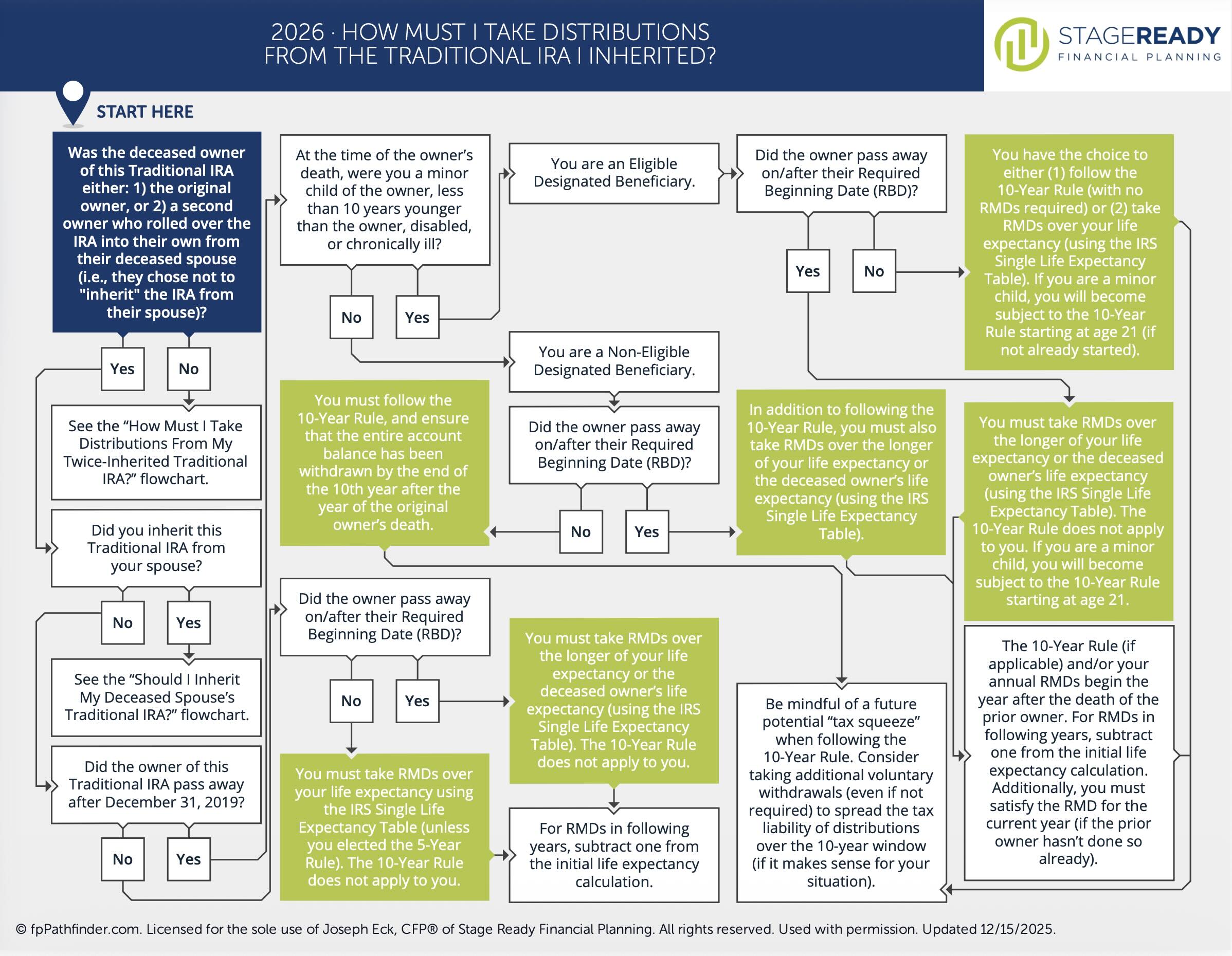
The 10-Year Rule
If you’re a non-spouse who has to follow the 10-year rule, the clock doesn’t start the day your loved one died. It begins on the following January 1. For example, if your grandpa died on September 18th, 2025, your 10-year window would be from January 1, 2026 to December 31st, 2035.
How you get to use the money in that window depends on whether the original owner passed away before or after having to take required minimum distributions (RMDs). This is also referred to as their required beginning date (RBD).
You don’t have to take RMDs:
If the owner died before their required beginning date (RBD), or if you inherited a Roth IRA, you have total flexibility. You can take a little bit out whenever you want, or leave it all in there until the very last minute. The only rule is that the account must be empty by December 31 of year ten.
Example: You inherit an IRA worth $100,000 from your Uncle who passed at age 68. Because he died before his required beginning date (RBD), you don’t have to take annual distributions. You can sit on the money for 10 years as long as it’s fully depleted at the end. It’s totally up to you.
You do have to take RMDs:
If they died on or after RBD, you’ll have to take an annual distribution. To calculate it, you’ll use the IRS Single Life Expectancy Table, find the factor for your age in the year following their death, and divide the prior year’s 12.31 balance by that number. For every year after, you take the previous year’s factor, subtract 1, and do the math again. Then whatever’s left has to be emptied by the end of year ten.
Example: You inherit an IRA from your Uncle who passed at age 77. Because he died after his required beginning date (RBD), you have to take annual RMDs. If the December 31 balance was $100,000 and your IRS life expectancy factor is 20, you’ll divide $100,000 by 20 to get your first required withdrawal of $5,000. In year two, your new factor is 19 (20-1), which you’d divide that year’s 12.31 balance by. The account still has to be empty by the end of year 10.
Eligible Designated Beneficiaries
The IRS grants exceptions to the 10-year rule that allow certain beneficiaries to stretch IRA distributions over the course of their life. These individuals are known as eligible designated beneficiaries (EDB).
You might be considered an eligible designated beneficiary (EDB) if you’re:
- A surviving spouse
- Someone who’s chronically ill or disabled
- Someone who’s older, or no more than 10 years younger
- Or a minor child
Under the minor child exception, they can only stretch the IRA distributions until age 21. Then the 10-year rule kicks in, and they have exactly one decade to empty the account. This exception only applies to the deceased’s actual children, not grandchildren.
The rules are a bit tricky, so it might be smart to lean on your tax professional or use an inherited IRA RMD calculator like Vanguard’s.
Example: You stopped working due to a disability right before you inherited your dad’s traditional IRA. You’d likely qualify as an eligible designated beneficiary (EDB) and wouldn’t be forced to empty the account in 10 years. Instead, you’d get to set up a stretch IRA. If the December 31 balance was $100,000 and your IRS life expectancy factor is 20, you’d divide $100,000 by 20 to get your first required withdrawal of $5,000. In year two, your new factor would be 19 (20-1), and you’d divide that year’s December 31 balance by that number. You’d repeat this process every year for as long as there’s money in the account.
Common Mistakes to Avoid after Inheriting an IRA
Inherited IRA mistakes can cost you thousands of dollars. Here are some easily avoidable issues:
- Missing deadlines: If you miss a required minimum distribution (RMD) deadline, the IRS imposes a 25% penalty on the amount you were supposed to take. If you fix it quickly, you can reduce it to 10%. Still, it’s an unnecessary and easily avoidable tax hit as long as you’re careful.
- Ignoring tax bracket management: Before deciding how to receive the money, figure out how it will impact your tax bracket, Medicare premiums, and more. Taking a lump sum at the wrong time could leave you with a frustrating bill down the road.
- Making decisions too quickly: If you take your time, you keep options on the table. But if you rush and take a large withdrawal, there’s no going backwards.
Real-Life Examples of Inheriting an IRA
Here are some common planning strategies that my clients have used when handling an inherited IRA:
Example 1:
Alan and Susan are married, and Alan inherits a $100,000 traditional IRA from his dad, who passed away at age 75. Because his dad was already taking required minimum distributions (RMDs), Alan will have to take withdrawals during the 10-year window. But he doesn’t just take the minimum and leave a big tax bill for year 10.
Alan wants to use most of the money for a home renovation. Susan points out that pulling the full $100,000 this year will push them into the 24% tax bracket. Instead, they decide to take $20,000 a year over five years. This satisfies the RMD and keeps them in a lower bracket, saving them thousands.
Example 2:
Pam is 60 and inherits a traditional IRA from her older cousin who passed away at age 72. She’s more than 10 years younger than her cousin, so she doesn’t qualify for the age exception. Pam has to follow the 10-year rule, but because her cousin died before reaching RMD age, she doesn’t have to take annual withdrawals.
Pam plans to retire at age 62, and she and her husband Jim have decided to delay taking Social Security until age 67. When she retires, their earned income is projected to drop to the 12% tax bracket. Instead of taking money out while she’s still working in the 24% bracket, she holds off. When she turns 62, she can take inherited IRA distributions at a lower tax rate to supplement their income until other benefits kick in.
Example 3:
Cindy is 58 and inherits a traditional IRA from her mother, who passed away at age 82. She has to take annual required minimum distributions (RMDs), but she’s currently sitting in a high tax bracket. She plans to retire at age 63, so for the first five years, she takes only the minimum required by the IRS. Once she retires, her income drops significantly. She can use the remaining years of her 10-year rule window to empty the rest of the account at a lower tax rate.
Get IRA and Retirement Help with Stage Ready Financial Planning. Contact Us Today for a Free, No-Commitment Consultation
If you’re the beneficiary of a retirement account and need help navigating options like the 10-year rule, Stage Ready Financial Planning is here to help. I specialize in helping pre-retirees and retirees across Dayton, Ohio, and the surrounding communities maximize their retirement income and get the most out of accounts like inherited IRAs.
Schedule your intro call today!
About Stage Ready Financial Planning
Fiduciary Financial Advisor Serving Dayton, Ohio. Retirement Planning that stays in sync with your life. Providing fee-only wealth management, designed to handle the math so you can enjoy the music.
Stage Ready Financial Planning helps retirees and savers over 50 throughout Dayton, Ohio and surrounding communities stay in sync with their goals through fee-only and fiduciary wealth management. Designed for households with $750,000+ invested for retirement, Joseph Eck, CFP® helps clients coordinate and implement retirement income, investments, taxes, and more into one cohesive strategy.
From orchestrating predictable retirement income to reducing unnecessary taxes and market noise, Stage Ready Financial Planning was built to help clients enjoy retirement with clarity, confidence, and financial harmony.
About Joseph Eck, CFP®

Joseph A. Eck, CFP®, is the owner and lead financial advisor at Stage Ready Financial Planning in Dayton, Ohio. He’s dedicated to helping retirement savers build and implement living, breathing financial plans. With years of experience, Joseph provides down-to-earth guidance on complex topics like inherited IRAs, reducing lifetime taxes, and making sure your investments are set up right for volatility in retirement. A proud member of the Dayton community, Joseph is committed to giving you the clarity and confidence you need to truly enjoy your retirement.
Frequently Asked Questions (FAQs)
Can I decline an inherited IRA?
Yes, you can disclaim the inheritance if you don’t want the money. If you execute a qualified disclaimer, the assets can go directly to the next named beneficiary. Though in practice, this doesn’t happen all that often. According to IRS Section 2518, you’ll need to submit a written disclaimer to the custodian within nine months of the original owner’s death, and you can’t touch any of the money first. This decision is permanent, and you can’t change your mind later, so it’s smart to talk with an attorney before making this call.
Can I roll an inherited IRA into my own IRA?
You can if you’re a surviving spouse who chooses a spousal rollover. With this option, the IRS treats the retirement money as if it was always yours. If you’re a non-spouse beneficiary, you aren’t allowed to roll the money into your personal IRA. You’ll have to keep the funds in an inherited IRA and follow the correct withdrawal rules based on your situation.
Can inheriting an IRA affect my Medicare premiums or Social Security taxes?
It can because taking distributions from an inherited traditional IRA increases your federal taxable income for the year. It can cause a larger portion of your Social Security benefits to become taxable. And if a large distribution spikes your income too high, it can trigger Medicare IRMAA surcharges. This means you’ll pay higher Medicare Part B and Part D premiums in 2 years.
How does an inherited IRA fit into my retirement plan?
If you inherit a traditional IRA and have to empty it under the 10-year rule, taking those distributions gives you cash to live on. That means you can let your own retirement savings compound longer. It can even open up opportunities to execute Roth conversions with your accounts. Be sure to consult your financial advisor and tax professional to craft a strategy that fits your tax bracket and income goals.
Article References
- Fidelity. “What to do with an inheritance – tips.” Accessed August 6, 2026. https://www.fidelity.com/learning-center/life-events/what-to-do-with-an-inheritance
- IRS.gov. “Publication 590-B (2025), Distributions from Individual Retirement Arrangements (IRAs).” Accessed August 10, 2026. https://www.irs.gov/publications/p590b
- IRS.gov. “Retirement topics – Beneficiary.” Accessed August 10, 2026. https://www.irs.gov/retirement-plans/plan-participant-employee/retirement-topics-beneficiary
- BoomTax.com. “1099-R Roth IRA Distribution Reporting.” Accessed August 10, 2026. https://boomtax.com/tax-forms/how-to-report-1099-r-for-roth-ira
- Vanguard. “Inherited IRA RMD Rules & SECURE Act 2.0.” Accessed August 10, 2026. https://investor.vanguard.com/investor-resources-education/retirement/rmd-rules-for-inherited-iras
- Fidelity Investments. “How to fix a missed RMD and reduce penalties.” Accessed August 10, 2026. https://www.fidelity.com/learning-center/personal-finance/missed-rmd-how-to-fix
- IRS. “IRC Section 2518 – PLR.” Accessed August 10, 2026. https://www.irs.gov/government-entities/indian-tribal-governments/irc-section-2518-plr
This communication is for informational purposes only and is not intended as investment, tax, accounting, or legal advice, as an offer or solicitation of an offer to buy or sell, or as an endorsement of any company, security, fund, or other securities or non-securities offering. This communication should not be relied upon as the sole factor in an investment making decision. Past performance is no indication of future results.